Producers
Producers are the ones who build the world before anyone steps into it. Before a verse is written, before a hook is recorded, before a record has a name, there’s a sound taking shape somewhere in the dark. This section exists to bring that process into the light.
A producer doesn’t just make beats. A producer sets the tone. The drums decide how something feels in your chest. The sample decides what memory gets triggered. The bass decides how it moves. Every choice carries weight. Tempo, texture, space, silence, all of it works together to create an environment the eMCee has to step into and navigate. That’s architecture.
HipHop production was built on transformation. Taking fragments of existing music and reshaping them into something new. Flipping a soul record into a street anthem. Turning a jazz loop into introspection. Pulling pieces from everywhere and making them belong in one place. That instinct to reimagine sound is still at the core of the craft. This section is built around that instinct.
Producers hear possibilities most people miss. A half-second of a record becomes the foundation of a whole track. A drum pattern becomes a signature. A texture becomes a feeling people can’t quite explain but keep coming back to. That ability to recognize potential and develop it is what separates beat-making from producing.
The details matter. Where the kick sits. How the snare cracks. The swing in the rhythm. The way a melody loops just long enough before it changes. The way space is used to let a verse breathe. These aren’t small decisions. They’re the difference between something that plays and something that sticks.
There’s also direction in it. A great producer can pull something out of an artist they didn’t know they had. By setting the right mood, by creating the right pocket, by knowing when to add and when to strip something away, they guide the performance without saying a word. The sound shapes the voice, and that influence runs deep.
Entire eras of HipHop can be traced back to production styles. The grit, the polish, the bounce, the minimalism, the complexity, all of it reflects the hands behind the boards. Producers don’t just follow the Kulture, they shift it.
This section exists to document, study, and elevate that role. From sampling techniques to sound design, from drum programming to arrangement, from the philosophy behind a record to the mechanics of how it’s built, this is where the foundation gets examined.


Alchemist
Alchemist is the second half behind most of the Kulture’s best nightmares and daydreams. He’s the standard. The bar. The watermark for what elite HipHop production feels like when it’s stripped down to its purest form.
Alchemist brought mood into the modern era. Not just beats, entire atmospheres. He paints with texture the way painters use shadows. Every loop feels like a memory that never fully healed. Every drum feels like it’s been through something. His sound forces eMCees to rap. No hiding behind melodies, no drowning under heavy mix tricks. His beats are bare enough to expose you, rich enough to elevate you.
He kept sample-based HipHop alive during an era when the industry tried its hardest to move away from it. While labels chased pop hooks, EDM crossovers, and type beats, Alchemist stayed digging, literally. Flea markets, record shops, private collections, warehouses, he kept the DNA of HipHop intact. Because of that discipline, he became the bridge connecting the ‘90s sound to the underground renaissance of the 2020s.
Then there’s the catalog, decades deep, zero falloff. Mobb Deep. Dilated Peoples. Evidence. Boldy James. Roc Marciano. Griselda. Freddie Gibbs. Earl Sweatshirt. Action Bronson. Planet Asia. Curren$y. There’s not a weak link in the whole chain. He’s shaped eras, revived careers, launched new ones, and given elite eMCees the canvas to craft their best work.
What makes him dangerous is that he never stops evolving. He went from grimy drum-heavy loops to minimalism. From smoke-filled soul chops to eerie cinematic fragments. From hard-hitting street joints to abstract, almost spiritual soundscapes. He’s constantly adding to the repertoire without ever abandoning the foundation.
Alchemist is the north star of craft, the proof that you can stay true, stay underground, stay weird, stay respectful, and still become a global powerhouse. He’s the blueprint for longevity, the quiet architect shaping the Kulture from the shadows. Every time an eMCee stands in front of one of his beats, the Kulture gets another reminder of what HipHop feels like when the music and the message meet at the highest level.
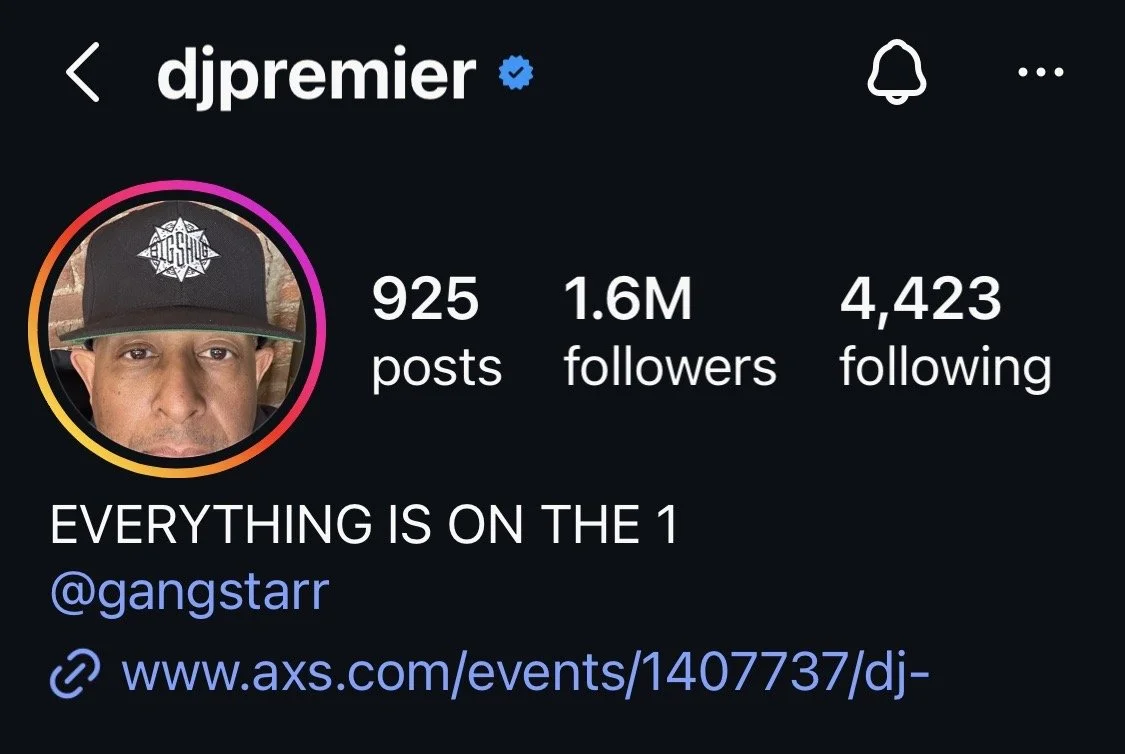
DJ Premier
DJ Premier is the pulse. He’s the snap of the snare that wakes you up. The chopped-up vocal scratch that feels like a sermon. The drum loop that hits your sternum with the truth. Premo built a whole language out of simplicity. He didn’t drown tracks in layers. He carved them down to the bone. A loop, a break, a scratch and intent. That’s all he needed. In his hands, that was enough to move the entire Kulture.
He’s the producer who turned beat production into a philosophy. No shortcuts. No flash for the sake of flash. Just discipline, precision, and skill. There are producers who make beats, and then there’s Premier, who makes statements.
eMCees knew a Premier beat is a rite of passage. The same way doing a tour run or rocking a certain stage is. If you were serious, you sought out your very own Premo production. He didn’t just give rappers beats, he gave them a launchpad. He made your pen sharper. He made your delivery cleaner. He made you respect your craft .
DJ Premier maintained the discipline and the structure that HipHop needed to stay HipHop. He represents mastery, innovation and tradition. Premier is a compass. When HipHop loses its direction, people will go back and listen to him to remember what the center feels like. He is the architect of clean grit, sharp truth, and pure Boom-Bap. As long as HipHop values authenticity, DJ Premier remains timeless.
DJ QUIK
DJ Quik is one of the clearest examples of what happens when a musician walks into HipHop with musicality already in his skillset. Most producers learn the boards first and develop an ear later. Quik came in already hearing arrangements, harmonies, basslines, transitions, the whole composition, before he ever touched the equipment. That’s why his sound always feels bigger than the room.
He’s a producer, an engineer, a writer, a musician and an eMCee. All at a high level and he treats each skill like a different instrument inside the same orchestra. That’s why you can always tell a Quik beat. The mix alone is its own fingerprint, warm bass, polished drums, live-band energy and that slick West Coast bounce that nobody else can mimic without sounding like a demo version of him.
Quik fused funk, soul, gospel chords, street storytelling and elite engineering into a sound that still feels futuristic. His mixes hit with clarity adjacent to perfection. He changed the expectation of what a producer could be. He built a catalog of collaborations that shifted the game. When Quik works with someone, it’s not just a feature, it’s a transformation. His touch brings out colors in artists they didn’t even know they had. That’s why so many legends hold him in a special category, not just producer-quality, composer-quality.
HipHop music isn’t only lyrical intelligence, it’s sonic intelligence. Quik elevated both. His work sets a standard for what West Coast excellence sounds like. Quik is one of HipHop’s clearest examples of what mastery looks like when craft, discipline, style and innovation move in the same direction. DJ Quik is a Kultural cornerstone, a musical architect, a West Coast genius and a HipHop Legend.
LARGE PROFESSOR
Large Professor is one of the architects who shaped the DNA of East Coast HipHop before most people even knew his name. Some producers build beats. Large Professor built blueprints. His sound is the foundation beneath entire generations, the technical ancestry behind half the New York style the world fell in love with. He taught producers that the mix matters. That sample selection matters. That rhythm is mathematics. That you don’t just search for a sound, you curate one.
He was one of the first to make sampling feel like a science. Not just looping records, but studying them. He treated the SP-1200 like a research lab, squeezing soul, jazz, drums, horns, voices and ghosted textures into patterns nobody else could decode. His beats weren’t just gritty, they were intelligent.
Large Professor didn’t just make classics. He coached legends. Before the world knew Nas, Large Professor was already sharpening that blade. He wasn’t just handing the kid beats, he was handing him standard. He recognized the talent early, nurtured it, and helped shape the cadence, the pocket, the discipline that would eventually build Illmatic.
Large Professor represents purity. The raw essence of HipHop. While the industry chased trends, he kept building legacy. He’s the type of figure HipHop looks at to remember what it means to be unapologetically HipHop. He doesn’t have to say it out loud. His persona says it. His influence says it.
Large Professor isn’t just a producer or an eMCee, he’s a cornerstone. One of the men who built the machine from scratch. A quiet giant whose work made noise for decades and HipHop will always echo with his fingerprints.
Mantronix
Mantronix is one of those names the Kulture whispers with respect, the kind of architect whose fingerprints are everywhere, even when people don’t realize they’re tracing his lines. Before sampling became religion, before drum machines became scripture, before electronic textures found a home in HipHop, Mantronix was already there, blueprinting a whole future.
Kurtis Mantronik wasn’t just ahead of the curve, he was the curve.
In the mid-80s, when most HipHop production was still rooted in breakbeats and party grooves, he came through with a sound that felt like it teleported straight out of tomorrow. Razor-sharp drum programming, synth stabs, digital funk, robotic basslines, tempo shifts. Sample fragments before sampling was even mainstream. His beats didn’t walk, they warped.
Long before HipHop producers were considered sound designers, Kurtis Mantronik was breaking machines open and pushing technology past its comfort zone. Producers today, from trap architects to EDM-HipHop hybrids, they’re moving through doors he kicked off the hinges. He could give you futuristic club energy one moment and cold, stripped-down Boom-Bap the next.
Fresh Is the Word. Bassline. Needle to the Groove. His touch reshaped how the world understood rhythm, the syncopation, the punch, the sequencing. You can hear his DNA in Miami bass, in UK electronic HipHop, in 90s club rap, in modern drum programming.
He took risks at a time when the Kulture had no safety net and no guarantees.
Mantronix proved that innovation isn’t optional, it’s how the Kulture breathes. He didn’t just influence sound, he helped define the idea that HipHop producers are inventors, scientists in the lab, engineers of frequency, mechanics of rhythm. He built a future the rest of the world is still catching up to.
Marley Marl
Marley Marl. He’s not just a pioneer, he’s one of the engineers of the entire sonic language the Kulture still uses today. Marley was the one who carved out the breakthrough that changed the science of HipHop production. He figured out how to isolate individual drum hits, kicks, snares, hats and rebuild brand new patterns from scratch. That move alone rewrote the rulebook.
You know how every producer today digs for crisp snares and legendary kicks, that entire mindset comes from the door Marley opened. He didn’t just make beats, he invented a production philosophy.
Marley didn’t just produce records. He built a roster. He had an ear for voices, flows, personalities, entire skillsets. The way a sculptor sees the shape inside the stone. MC Shan, Biz Markie, Kool G Rap, Craig G, Roxanne Shanté, Big Daddy Kane, Masta Ace. He didn’t just work with legends, he helped shape them. He wasn’t running a crew, he was running an institution.
While the industry shifted, Marley stayed active, radio, production, live sets, interviews, sound design, mentoring, teaching the next generation how to respect the lineage. His legacy isn’t just records. It’s a long trail of people who learned from his methods and carried the torch forward. Marley Marl is proof that HipHop isn’t built off trends, it’s built off the people who push the boundaries and leave the game permanently changed.
Marley Marl is the reason HipHop learned how to sound like HipHop. He showed producers that they weren’t just beatmakers, they were architects. He gave Queensbridge a sound that echoed across the world. His drum programming, sample science, and studio style, is what producers still use today. All rooted from his experimentation. He isn’t just part of the Kulture, he helped design the damn skeleton.
Marley Marl is one of the few people in HipHop whose contributions never fade, they compound.
The MPC
The MPC ain’t just a machine, it’s a portal. A whole generation of producers used that box to bend time, flip memory and talk to the universe. You could hand an MPC to somebody with nothing but curiosity and a dusty crate of records and somehow they’d walk away with a whole symphony that sounded like their block, their childhood, their scars and their dreams all stitched into one beat. That kind of magic don’t happen by accident.
HipHop changed once the MPC gave everyday kids the power to reshape the world through sound. Before the MPC, sampling was possible, but it wasn’t this fast, this tactile, or this emotional. The pads let you play your imagination. The timing made it feel like drumming on the front steps. The swing gave beats that human pulse, that imperfect perfection that made rhythms feel lived-in, not programmed. It made producers into musicians, and musicians into scientists.
The release of the MPC democratized the whole craft. You no longer needed a million-dollar studio or a classically trained background. You just needed taste. Ears. Hunger. A want for the world to hear something only you could hear. The MPC turned bedrooms and basements into laboratories and the Kulture never looked back. HipHop has always been about turning limited resources into limitless expression and the MPC is one of the purest embodiments of that spirit.
Deeper than the tech, the MPC matters because of the communities it built. Producers swapped beats like trading cards, battled for bragging rights, taught each other tricks and made each other better without even knowing it. That little gray box created friendships, rivalries, movements, whole eras. When you heard a producer’s signature swing or pattern, you knew who it was like hearing a voice. The MPC gave producers a fingerprint.
Even now, in the digital age, with software that can do a thousand times more, the MPC still stands as a sacred relic and a living instrument. It’s the Rosetta Stone of HipHop production, the device that taught us how to speak beat fluently, emotionally, intentionally.
PAUL C
Paul C is one of those names the casual listener might gloss over, but anybody who really studies HipHop knows he’s one of the most important architects the Kulture ever had. He’s the producer your favorite producer studied. The blueprint behind the blueprint.
Before SP-1200 mastery became a badge of honor, Paul C was treating that machine like a Stradivarius, pulling textures out of it nobody thought were possible. His ear was crazy, clean chops, warm basslines, drums engineered so sharp they felt like they were cut with a scalpel. He wasn’t looping blindly. He was orchestrating, building arrangements with a musician’s patience and an engineer’s discipline.
Paul C stood at the crossroads between old-school and golden-age production and he helped push HipHop into its most technical era. His fingerprints show up in the DNA of legends, Large Professor especially, who carried Paul’s teachings into a whole generation of beatmakers who didn’t even realize where their lineage started.
What made Paul special wasn’t just the sound, it was the science behind it. Dudes would walk into his sessions and swear he had some secret piece of gear nobody else owned. But the truth was simpler, he actually understood the equipment. He wasn’t guessing. He was engineering. Because of that, his style became the silent foundation of East Coast production, crisp drums, warm low-end, tight timing, smart sampling and humility in the mix, nothing wasted, nothing sloppy.
Paul never got the years he deserved. His life was cut short before the world could grasp how far he would’ve taken HipHop. But the echo of his work lives everywhere, in every chopped break, every clean SP-1200 pattern, every producer who values precision over hype.
Paul C helped define the sound of the golden age before it even had a name. He raised the technical standard for sampling and engineering. He mentored producers who went on to reshape the entire Kulture. He proved that you don’t need fame to change the future, you just need mastery.
Paul C is one of HipHop’s sacred names. A craftsman’s craftsman. A reminder that greatness isn’t always loud, sometimes it’s tucked behind the boards, building the blueprint everyone else ends up using.
Pete Rock
Pete Rock is one of those architects whose fingerprints are everywhere, he didn’t just contribute to HipHop’s sound, he reshaped the ears of the entire Kulture. Pete Rock’s production is like velvet. Smooth, soulful, heavy and warm. He mastered the art of sampling the way a sculptor masters marble. Pete didn’t just grab records, he resurrected them. He treated every horn stab, bassline, and vocal riff like sacred fragments from an older world, stitching them together with a sense of grace, rhythm, and emotional weight that nobody had touched before him. Those brass sections, those dusty crackles, those lush layers that feel like the sun breaking through a cloudy Mount Vernon morning. Yup, that’s a Pete Rock beat.
Pete made beats that felt like lineage. Beats that felt like family. He kept the Kulture spiritually connected to gospel, jazz, soul, and blues, reminding everybody where this music came from, not just where it was going. They Reminisce Over You (T.R.O.Y.) isn’t just a record, it’s one of HipHop’s sacred artifacts. A moment where production and emotion fused so perfectly that the Kulture had to stop and inhale it. To this day, that track is studied like scripture.
Pete Rock is a bridge-builder. He fed both coasts. He fed the South. He fed the underground. He fed the mainstream. He fed generations. If you were a serious eMCee, especially during the ’90s, a Pete Rock beat wasn’t just an opportunity, it was a rite of passage.
Pete Rock is, Soul Brother #1.
He kept the soul in HipHop timeless. Pete’s influence echoes in every Neo-Soul producer, every lofi beatmaker, every sample-based purist, every kid digging in crates on YouTube, every dusty snare worshipper and every modern eMCee who knows the importance of texture and tone. His entire career proves that HipHop’s heart beats strongest when the music remembers its roots.
He anchored the Kulture to its emotional core. He elevated production into poetry. When HipHop looks for warmth, depth, and soul, it looks toward one man, Pete Rock.
LARRY SMITH
Larry Smith is one of the most important producers in HipHop history, the kind of architect whose fingerprints are all over the foundation, even if half the Kulture doesn’t realize they’ve been walking on his blueprints for 40 years. He’s the bridge between live-instrument funk and early-era rap. He’s the reason certain drums feel like concrete and certain basslines feel like hand-to-hand combat. He’s the man behind some of the most influential records to ever come out of New York, period.
This is the guy who helped define Run-DMC’s entire sonic identity. The stripped-down drums. The cold-steel minimalism. The no nonsense attitude in the production. When people talk about HipHop leaving disco behind, stepping out of the party era and walking into the streetlights, that pivot, that tone? Larry Smith is at the center of that shift.
Let’s add Whodini into the picture. Larry crafted some of the earliest fully-formed HipHop songs with structure, melody, storytelling, and musicality. Friends, Freaks Come Out at Night, Five Minutes of Funk, that’s Larry engineering the personality of early HipHop radio. That’s him giving HipHop its first taste of widescreen polish while still keeping the grit intact. But before all that, there’s the Kurtis Blow connection. He played bass and co-wrote on a couple of Kurtis’ songs, like Christmas Rappin’ and The Breaks. Working with Kurtis is what led him to meeting Russell Simmons.
His role is deeper than a few credits. Larry Smith showed HipHop that it didn’t have to choose between raw and musical. It could be both. It should be both. Producers who came after him learned directly or indirectly from Larry’s approach, make the drums speak, make the bassline walk, leave room for the eMCee to breathe and never overproduce a record that’s supposed to hit like a closed fist.
Larry Smith helped establish the sonic identity of early HipHop. He shaped the sound of Run-DMC, one of HipHop’s most important groups. He crafted some of Whodini’s biggest records, songs still sampled, referenced, and celebrated. He proved HipHop could be hard, clean, musical, and mainstream without losing its street DNA. He influenced producers who went on to build the next three generations of HipHop. Larry Smith is one of the gods behind the curtain. A pioneer whose work didn’t just age well, it became the standard.
Statik Selektah
Statik Selektah is one of those producers who reminds the Kulture that HipHop didn’t lose its traditions, you just gotta know where to listen. He’s a bridge-builder, a curator, a craftsman who treats drum patterns and sample chops like a chef treats spices. If the Kulture had a sommelier, Statik would be the one pouring up the vintage. He’s a connector, the guy who can get legends, newcomers, underground assassins and mainstream stars on the same track without feeling forced.
He’s one of the last producers carrying the tradition of discovery. He’s a mixtape era architect who’s responsible for what voices the Kulture hears next. Before playlists existed, Statik was the playlist. His early radio and mixtape runs put countless eMCees in rotation long before algorithms learned their names. His catalog is a museum of unlikely pairings that make perfect sense once the beat drops. Statik knows exactly how to build a track that brings out the best in everyone.
Then there’s the albums. Statik produces albums the way they used to be done, curated, cohesive, packed with verses that feel like artists brought their A-game out of respect for the environment. He treats every project like an event. Beneath the résumé is the craft itself, warm drums, soul samples, jazzy textures, modern knock mixed with classic sensibility. Statik never abandoned HipHop’s foundational sound, that’s why every Statik beat feels like a reminder, HipHop’s DNA still hits when it’s in the right hands.
He’s one of the most selfless figures in the game. He constantly reaches back, shines light on rising talent and gives them space next to giants. When Statik cosigns someone, it feels earned. It feels intentional. It feels like a vote of confidence from a man whose ear has been trusted for decades.
Statik Selektah represents the continuity of HipHop. A producer who honors the past, elevates the present and protects the future, all at the same time. He’s proof that you don’t need a gimmick or a trend-chasing beat to stay relevant. You stay relevant by staying excellent. Statik is proof that the Kulture is alive, well and still in good taste.
9th Wonder
9th Wonder is one of those rare producers who managed to bridge the academic world, the underground and the mainstream without ever leaving the soul of HipHop behind. He came up digging through dusty crates, chopping samples on FruityLoops and flipping gospel, jazz and ’70s soul into something that felt ancient and futuristic at the same time. He positioned HipHop as a legitimate, Kultural, intellectual and artistic force everywhere he stepped.
His early work with Little Brother set the tone. Warm, unpretentious soul loops carrying razor-sharp lyricism, showing the world that backpack rap wasn’t just alive, it was elite. Records like The Listening and The Minstrel Show became blueprints of indie excellence and 9th’s fingerprints were all over the psychology, pacing and musicality of that era. He proved that you didn’t need million-dollar equipment or industry co-signs to make classic work. You just needed taste, discipline and a feel for the Kulture.
Then he crossed into the mainstream without ever switching his principles. Jay-Z, Destiny’s Child, Erykah Badu, Mary J. Blige, Kendrick Lamar, Anderson.Paak, 9th brought that same college-radio soul to arenas and radio stations worldwide. He made commercial records feel authentic and underground records feel important. That blend is something only a handful of producers in history ever pulled off.
His biggest impact might be in the classroom. 9th walked HipHop straight into universities, Harvard, Duke, NCCU and treated beatmaking with the same academic respect as classical composition or jazz theory. He didn’t just argue that HipHop deserved to be studied, he built the curriculum, taught the classes and archived the Kulture with the precision of a historian. That move helped legitimize the craft for future scholars, proving that HipHop scholarship belongs in the same rooms as the humanities, philosophy and fine arts. Behind all of this is his role as a mentor, putting young artists on, building the Jamla roster and teaching new generations of producers how to trust their ear, not the trend.
9th Wonder is bigger than just beats. He’s Kultural infrastructure. A thinker, a teacher, a curator, a bridge between eras. He turned sampling into Kultural preservation, classrooms into cyphas and HipHop from street music into something worthy of libraries, textbooks, and lifelong study.